
Know where every part is on the line
A line stops because one part never arrived. A torque wrench has vanished again. A batch passed a station and nobody can prove it. On the factory floor, a small gap in what you know becomes a big gap in the schedule.
What slows the shop floor
Work in progress out of sight
Between stations, parts sit in carts and racks. The system knows what entered and what finished. Everything in between is guesswork and walking.
Tools and assets that wander
Tools, molds and containers are shared and moved all day. When one disappears, a line waits or a replacement is bought, and nobody remembers who had it last.
A hard place for electronics
Metal, dust, rain and forklifts are routine. Gear made for an office counter will not last at a yard gate or beside a machine.
How RAIN RFID changes it
- 1
Parts and tools carry a tag
A standard RAIN RFID tag goes on the part, the cart or the tool. You choose the tag. Metal and plastic behave differently, so test with samples.
- 2
Stations report by themselves
A reader and antennas at each station note what arrived and what left. No one stops to scan, and the line keeps moving.
- 3
Gear made for the place
The EM300H is IP67 for outdoors, decodes GS1 codes on the reader, and its 8 MB buffer keeps reads if the network drops, then syncs them back.
- 4
Built into your own machine
Machine makers embed MB or SAM modules, 32 x 36 x 4 mm. SAM runs your code on the module itself.
WIP: where each part is on the production line
WIP (work in progress) is everything between raw material and finished goods: parts, subassemblies and lots moving between stations. When the status of each WIP item depends on a paper form or a radio call, the line stops to look for it and the bottleneck stays hidden.
Status at each station
A reader at the entry and exit of each station records which carrier or lot arrived and left, with the time, so the supervisor sees where the flow is blocked in real time.
Lots and carriers traced
Tags on totes, carriers or pallets carry the lot or serial of the order. Any item can be located on the line in seconds, which cuts searches and mismatches at the end of the shift.
Checks without stopping the line
Conveyor tunnels and portals check boxes and totes while they move. A handheld covers manual stations and rework, and writes to the same record in the system.
RFID applications in manufacturing
- 1
WIP (work in progress) control between stations
The status of every part between stations is known without a paper form. The supervisor sees the bottleneck while it is forming, not at the end of the shift.
- 2
Tracking of tools, molds and devices
Tools that are shared between shifts always have a last known location. Work stops less often waiting for a mold, and replacements are bought only when they are really missing.
- 3
Identification of parts and subassemblies on the assembly line
Each subassembly carries its identity from station to station. The right part reaches the right station, and a wrong part is flagged before it is assembled.
- 4
Quality control and rework recorded per item
Rework is tied to the item, not to the batch. Quality knows which unit went back to the line, why, and how many times, which makes root-cause analysis faster.
- 5
Component traceability for standards and audits
Every component is linked to the product it went into. An audit gets the history of a unit in seconds, instead of a search through paper folders.
Passages between production areas, with direction
Carts, bins and tools that move from one area to the next cross a door or a corridor. Two tilted antennas, one looking at the approach and one at the way out, read the tag on both sides of the line: A then B means it went in, B then A means it came out. The GateView OTP ships with the two antennas already aimed this way.
Recommended setups
Production stations
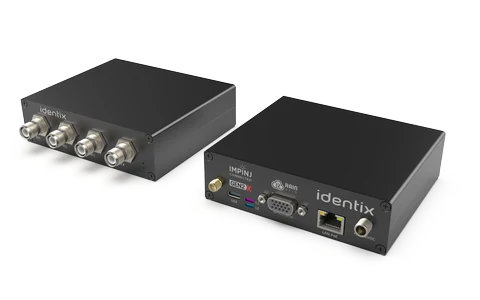
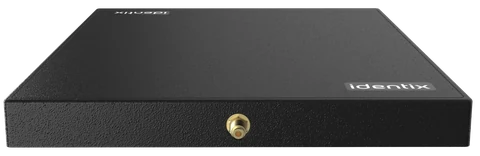
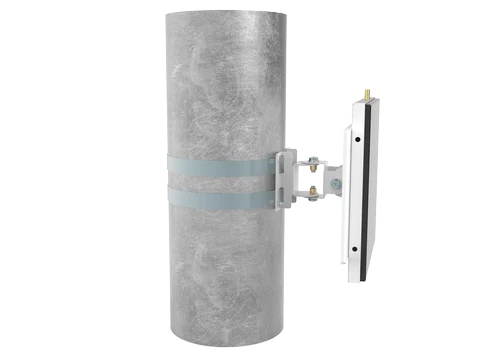
Problem: work in progress out of sight. An EZ500 or EZ700 industrial reader with 85C7070 antennas at each station. Four antenna ports, PoE or 9 to 28 V DC. Dense Reader Mode copes with crowded RF.
Yard gates and tool rounds
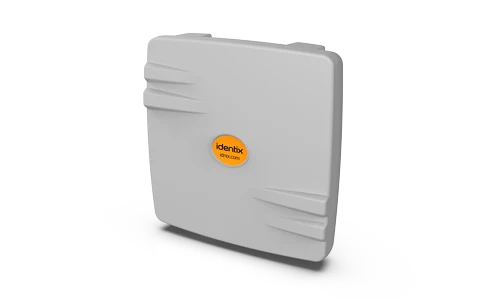
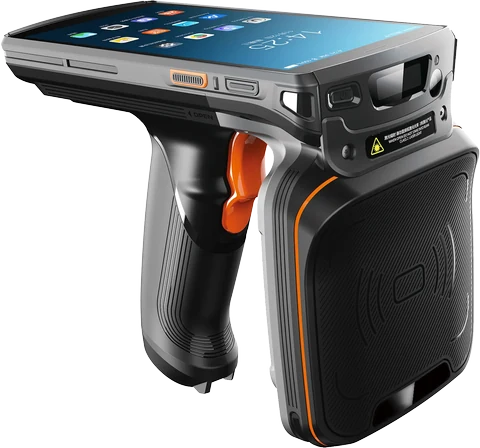
Problem: assets leaving unseen. An EM300H, IP67, with its built-in 7 dBi antenna reads vehicles and loads at the gate. An ID50 handheld, also IP67, covers the rounds for tools and containers.
Your own machine or product
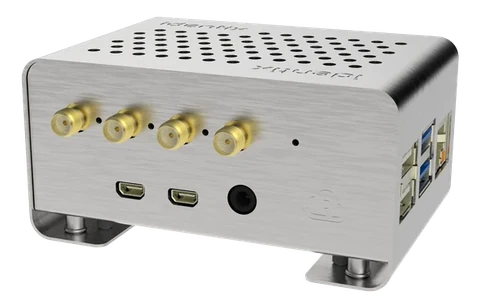
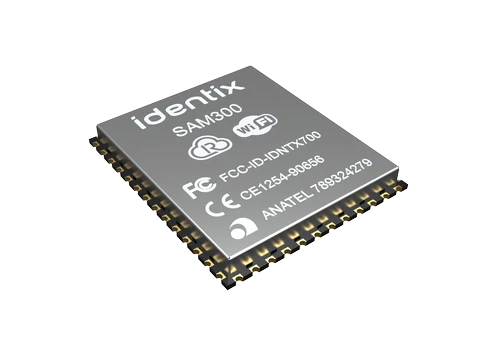
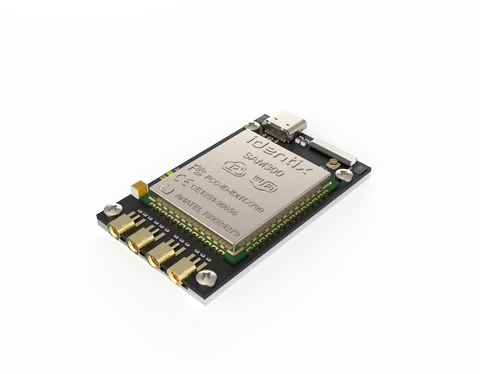
Problem: you build equipment, not readers. Prototype on a SAMDK board, a Raspberry Pi carrier, then move to a SAM module on your own board. Use an MB module when an external host runs the logic.
What you gain
Work in progress you can see
You know which station holds which batch without walking the floor. Delays show up while there is still time to act.
A last-known place for every tool
Each pass through a reader leaves a trace. The question of who had it last finally has an answer.
Hardware picked for the floor
IP67 for the yard, industrial readers with DC power for the line, or a module inside your own machine. The reader fits the place.
Questions we hear
Do you sell the tags?
No. Identix supplies readers, antennas, modules and accessories. You choose standard RAIN RFID tags for your parts and tools. Tags behave differently on metal, so test with your own items first.
Can a reader work outdoors?
The EM300H has an IP67 housing and a built-in dual linear 7 dBi antenna, made for gatehouses, logistics yards and vehicle access. It also has two SMA ports for external antennas.
What if many readers work close together?
That is normal in a plant. The EZ500 and EZ700 have Dense Reader Mode and Self-Jamming Cancellation, built for crowded RF environments. Antenna aiming matters too, and the articulated support helps with it.
Can we build our own device with your modules?
Yes. MB and SAM modules cover 865 to 928 MHz with the band set by software, and are FCC and Anatel certified. SAM modules run custom applications on the module, alone or with a host.
Products for this solution
EZ series
Industrial fixed readers: pick by speed and sensitivity
Details →EM300H
IP67 outdoor RAIN RFID reader with built-in 7 dBi antenna
Details →ID50
Rugged Android RAIN RFID handheld, over 1,100 tags/s
Details →85C7070
Circular-polarized RAIN RFID panel, 8.5 dBiC, 70° beam
Details →Universal Articulated Support
Articulated aluminum mount for any Identix antenna
Details →SAM series
RAIN RFID System-on-Modules with programmable output up to +33 dBm
Details →MB series
Multiregional RAIN RFID modules, 32 × 36 × 4 mm
Details →Tell us about your site
Read zone, number of items, environment. We reply with the setup that fits.
Talk to an engineer